

Onion is a horticultural vegetable crop which have short, modified, underground stem surrounded by usually fleshy modified leaves that contain stored food for the shoot within an onion bulb.
Herbaceous biennial plant, probably native to South Asia but now grown worldwide, and its edible part is bulb. Among the hardiest and oldest garden-vegetable plants, onions bear a cluster of small, greenish white flowers on one or more leafless stalks. The leaf base swells to form the underground mature edible onion. Onions are pungent; because they contain a sulfur-rich volatile oil, peeling or slicing them can cause a person’s eyes to tear. Onions vary in size, shape, colour, and pungency. Though low in standard nutrients, they are valued for their flavour. Onions have been claimed to cure colds, earaches, and laryngitis and have been used to treat animal bites, powder burns, and warts; like their close relative garlic, they are being studied for other suspected beneficial qualities.
TYPES AND VARIETIES OF ONIONS
Four types of onions are known; these are green (scallion), yellow, red and white
Varieties: Although many varieties of onion are found in Tanzania, two varieties are of particular importance in term of volume of production .These varieties are Bombey red and Red creole. Bombey red are maintained in different areas and a good example is popular Mang’olared, which is maintained at Tengeru and Mang’ola in Arusha region. Other varieties such as Taxasgrano and Early Red are produced in some areas in Tanzania. There are many onion varieties, but the most common in Tanzania are Red creole, Bombay red, White granex and Shite hybnowwrid.
- White types: The mildest of all onion varieties, usually white on the outside and inside. White types include varieties such as white granex and snow white hybrid.

- Yellow types: Can be used raw, cooked or pickled, Usually the sweetest varieties, gold skin on the outside, off-white/ light yellow flesh, usually the best varieties for cooking , other yellow varieties are Texas Super sweet, Granex yellow Hybrid, Walla walla sweet, Candy hybrid.
Texas grano
- Red types: Often prepared raw in salads san Red skin and white crispy flesh dishes (western world). Most cultivated varieties in Tanzania are Bombay red and Red creole.
CLIMATE AND SOIL
Soil: Onions can be grown successfully on any fertile, well-drained, non-crusting soil. The optimum pH range, regardless of soil type, is 6.0 to 6.8, although alkaline soils are also suitable. Onions do not thrive in soils of pH below 6.0 because of trace element deficiencies or, occasionally, aluminum or manganese toxicity. Onion is a cool season, tolerant of frost. Optimum temperatures for plant development are between 13 and 24°C, although the range for seedling growth is narrow, 20 to 25°C. High temperatures favor bulbing and curing.Rainfall: 500- 600 mm / annualAltitude: 2500 m above sea level
CULTURAL MANAGEMENT
Nursery: Raised nursery beds 1 m wide with convenient length beds, 10-15 cm between drills, Depth about 1-2cm (light soil cover), Cover the beds with dry grasses/mulch.Land preparation: Ploughing and harrowing, ridges preparation for bulb formation and manure application (20-30 tons/ hectare).Seed rate: Onion seeds are sown in nursery beds to raise seedlings for common big onions, 8-10 kg seed is sufficient for raising seedlings for one hectare; accommodating 100-110 beds of 3m X 0.6m size each. For broadcasting directly in the field or sowing in the rows, 20-25 kg seeds are enough for a hectare. For multiplier onions 10-12 quintal bulb lets are required for planting one hectare.Water once or twice per day and Germination period is about 7-10 days.
PLANTING
Two systems of planting may be employed;i) Direct seeding is preferred and gives excellent results where the season is sufficiently long to provide early pre-bulbing growthii) Transplants normally have three to five well-formed leaves at transplant time. Transplant leaves are pruned during growth prior to field setting, facilitating handling and increasing plant hardiness.
Spacing:Prior to planting, soils should be ploughed and disked sufficiently to eliminate debris and soil clods. In most commercial areas, beds 0.9 to 1.0 m wide are formed; and two to six rows are seeded.Onion seedlings are normally sown 4″ (10cm) to 6″ (15cm) by 8″-12″ (20-30cm) apart. Closer spacing produces smaller bulbs but there is no point going over 6″ (15cm) apart unless you are trying to grow giants. Incidentally, large sets are more prone to bolting so do not discard small sets in the pack in favours of them.
MANURING AND FERTILIZER APPLICATION Onion responds very well to organic manure. Organic manure 25 to 40 tones/ha is recommended to obtain high bulb yield.Fertilizer is applied either as a broadcast or, more commonly, as a band 5 to 10 cm directly below the seed, set, or transplant. Onion plants utilize substantial amounts of nutrients. Based on a yield of 18 t/ha of bulbs, the plants take away an average 66, 11 and 70 kg, of N, P and K respectively. Soils differ widely infertilizer needs, depending on production history, soil type, and analysis. Earthing up: Pulling up the soil around the bulb encourages bulb development Helps to prevent sun scotch.
IRRIGATION AND WEED CONTROL
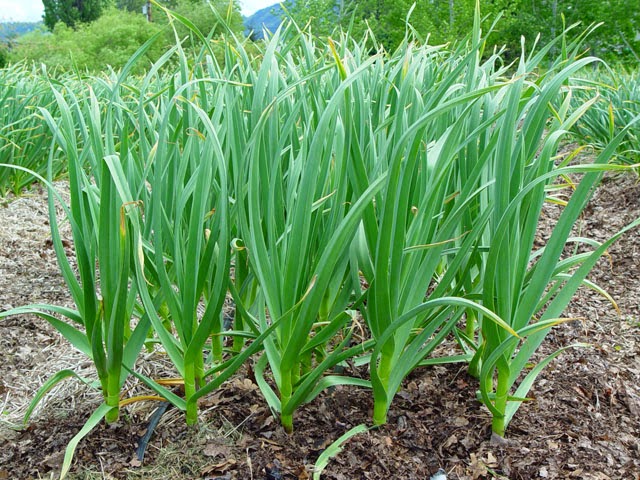
Onions require uniform moisture throughout the growing season. Fields that suffers growth retardation may produce excessive numbers of doubles or splits, reducing the number of Grade 1 bulbs. Furrow irrigation is generally used. Light sandy soils are irrigated with overhead systems or by subsurface seep irrigation where the soil profile allows. Onions at the bulbing stage utilize substantial amounts of water, although excessive moisture must be avoided during the growing season.Onions are not good competitors with weeds. Cultivation, if used, must be shallow to avoid root damage, and growers usually favor chemical control. Pre-emergent broadcast applications organic compounds have been used with some success.
HARVESTING, CURING AND STORING
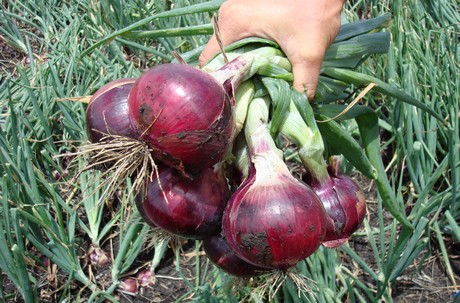
HARVESTING;Harvest onions at optimum maturity. Maturity is best determined by pinching the neck of the growing onion. Necks of immature onions are stiff, whereas necks of mature onions are soft and limber.Undercut onions with a rotating bar or fixed blade when mature and necks are soft and limber. The blade or rotating bar should operate at approximately 1 inch below the bulb, so as not to damage their bases. A rope is often dragged across the top of the onions at the same time to roll the onions out of the ground and expose the roots. Make every effort to prevent excessive bulb exposure to the sun, which will cause the onion to blister. Gather onions within a few days of undercutting. If light rain occurs during field drying, undercut the onion beds a second time. This will break soil that has re-attached to the bulb.After onions have field dried for 3-5 days under sunny dry conditions, remove the roots and tops of the onions. Tops are cut at approximately 1.5-2 inches above the bulb and roots cut off completely. Extra short necks increase the likelihood of disease infection. During clipping, take care to prevent injury to the bulbs with the shears and by dropping the bulbs onto hard surfaces such as the bottom of buckets and other onions. Hand harvested bulbs are usually placed into burlap or mesh bags in the field and transported by truck to packing sheds. Always handle onions carefully to avoid external and internal damage, especially when loading onto the hard surface of truck bodies. Avoid walking and standing on bags of onions. Place the bulbs in bins or boxes with at least 6 percent vent space. Immediately place the bins on a drying system. Remaining roots will shrivel during curing and will be knocked off on the packing line. Necks should dry during curing and fold over when handled.
CURING; Bulb quality is the most important factor when producing a marketable product. To ensure maximum quality, artificially cure onions. Artificial curing allows the grower better control over the curing process. During years when excessive rains and unfavorable drying conditions occur in the field, artificial curing will be required.Onions are cured in order to extend their shelf life. An onion bulb is a series of concentric swollen leaves still attached to a short stem or base. These are surrounded by scales, which are dried leaves. Curing of onion bulbs serves several functions. First it dries the outer two to four scales, providing mechanical protection. It dries those roots remaining attached to the bulb following undercutting and the neck left attached to the crown following topping, deterring disease infection. Lastly, curing encourages dehydration and the sealing of wounds that may have resulted during bulb growth or mechanical damage. The term “curing” rather than “drying” of onions is preferred because the removal of moisture is limited to the parts mentioned while protecting the high moisture content of the flesh inside the bulb. This differs from drying other commodities such as peanuts or grain, where moisture is removed from inside the seed or kernel. Onion bulbs consist of a high proportion of water (approximately 90 percent) and desiccation of the bulbs must be avoided.Under dry conditions, bulbs may be left to cure in the field, either in place or in windrows. To avoid damage from direct sunlight, however, onions normally are placed in field containers and moved to a dry, shady location for subsequent curing.
Packaging;

Packing should be small for easy handling during transit and may vary according to market demand. Onions are packed in jute (hessian) bags for transporting to yard or brought as loose. For safe handling, 40 kg open mesh jute bags having 200-300 g weight should be used in domestic market. For export, common big onions are packed in 5-25 kg size open mesh jute bags.
Handling; Bulbs intended for storage must be free from cuts and handled with extreme care. Onions should not be dropped on to non-resilient surface from more than 6 feet height. If onions are to be stacked after packing in store or trucks, the better height is 2-2.5 metres. Losses due to rot is reported to be more if onions are stored in gunny bags than in loose or wooden crates.
Storage; Proper storage of bulbs is necessary both for consumption and also for seed production. Onions should not be stored unless adequately dried either in the field or by artificial means. It is necessary to dry the neck tissue and outer scales until they rustle when handled otherwise the bulbs will rot in storage. Sprouting in onion is controlled by temperature.The temperature between 10-25°C increases sprouting. Rooting is influenced by relative humidity (RH). More the relative humidity more is rooting.The salient features of improved storage structures are as below-Construction of storage goes down on raised platform helps in reduction of moisture and dampnessUse of Mangalore tiles roof or other suitable material prevents built up of high temperature inside. Increased centre height and more slope is better for air circulation and preventing humid microclimate inside go down. Bottom ventilation provides free and faster air circulation to avoid formation of hot and humid pockets between the onion layers.Avoid direct sunlight on onion bulbs to reduce sunscald, fading of colour and quality deterioration.
YIELD AND MARKET IMPORTANCE
60-100 tonnes of onions per hectare can be obtained under good management.At Morogoro market, the red onions prices ranges from 1200Tsh to 1400Tsh per Kg.